
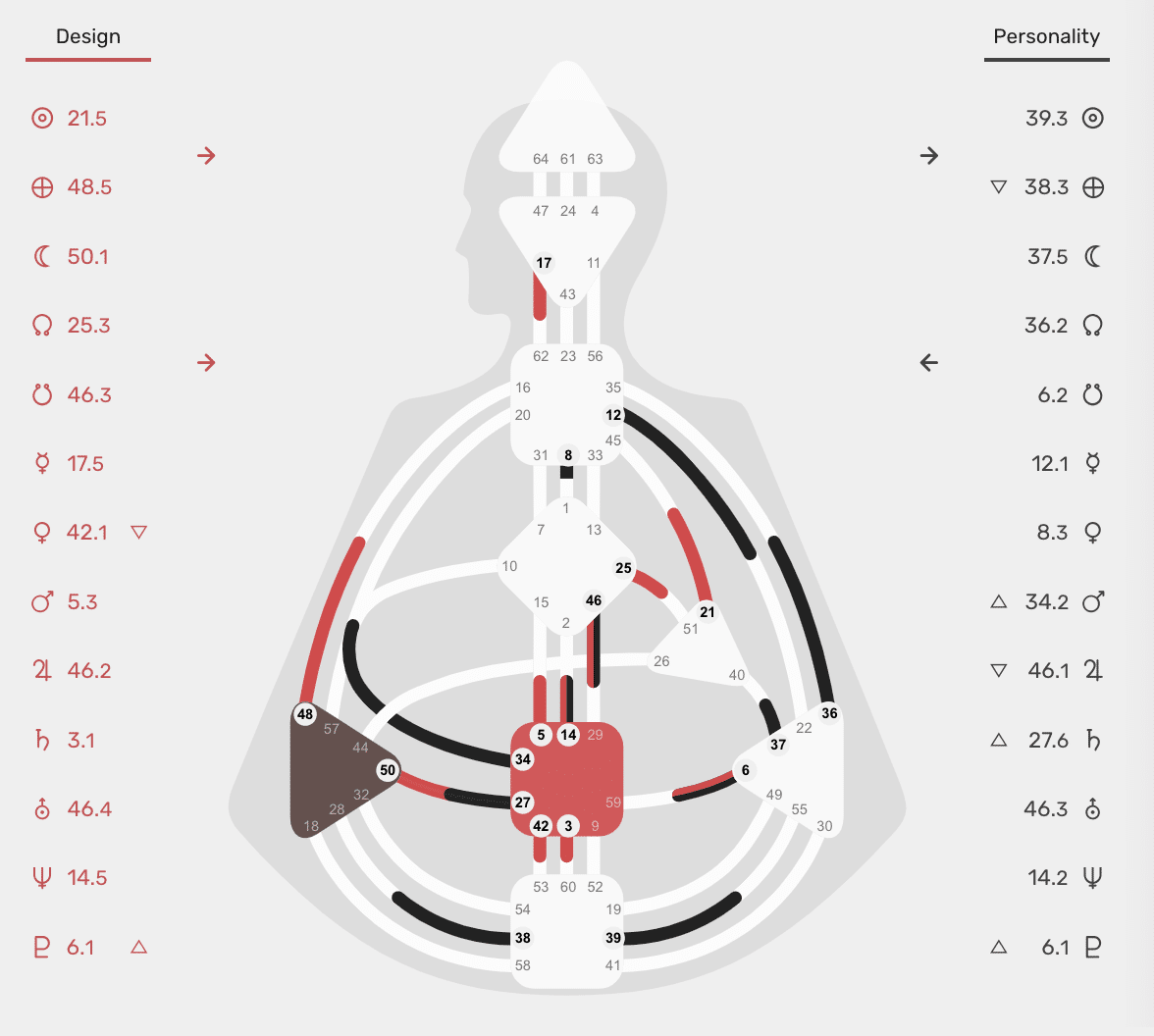
Human Design is growing — fast. Especially over the past six months. Until recently, it was mostly a practical tool for a small group of people who stumbled upon it by chance — a way to truly become yourself. That’s also how it was introduced to the world by its founder, Ra Uru Hu. According to his own words and experience, Human Design is relevant to only 4% of humanity — and of that 4%, just a small portion will actually integrate it into their lives. That means making decisions based on who they truly are, rooted in their strengths instead of their patterns or pitfalls.
But now Human Design is beginning to go mainstream. And that’s a good thing — because it’s a profoundly powerful system. It doesn’t just give us insight into ourselves, into others, or into what’s happening between us in our relationships. Its real power lies in how it transforms our lives. When you enter into the experiment of making decisions based on your inner compass, something begins to shift. Life starts to align.
Depending on your type and design, feelings like satisfaction, success, peace, or surprise begin to replace frustration, bitterness, anger, or disappointment. The resistance and helplessness that often follow from misaligned choices begins to fade. You start to feel more flow. Life begins to move naturally — because the mind no longer dominates the way you live.
That’s the great power of Human Design: It helps you make reliable decisions — not based on logic or emotion, but on your unique inner authority. Most of us have been trained to use our mind to make decisions — it’s the only way we know. Some people try to listen to their feelings, their intuition, or their heart. But often these are vague, fleeting signals, used mostly for smaller decisions in love or friendship. When it comes to big choices — Where should I live? What should I study? Should I take out a mortgage? Should I begin or end this relationship? — we tend to rely on the mind. We ask advice from friends or family. We hire experts. We search the internet to see what’s “normal” or “smart.”
But if Human Design teaches us anything, it’s that there is no such thing as “normal” or “sensible.” Statistically, after analyzing the designs of millions of people, it becomes undeniably clear: no two people are exactly the same. We are all unique — not as some vague affirmation, but demonstrably so, down to the smallest detail of who we are. This uniqueness shapes us from birth to death.
At first glance, we may appear similar — but that’s largely due to our openness. When you look at a Human Design Bodygraph — the chart that shows how energy flows through you — you’ll see centers: boxes that are either colored or white. The colored centers represent the energy that is consistently present in you. This is your reliable, fixed energy — whether or not you’re consciously aware of it. The white centers are open to the outside world. This is where you meet others. This is where you experience, learn, and are most influenced. And here lies the paradox: We are mostly unaware of who we truly are, but highly aware of what we are not. And that’s where the confusion begins.
In the first years of life, our mind becomes overwhelmed by the energy flowing through our open centers. On their own, these centers remain quiet. But the moment another person enters our aura — the energy field around us, about two arm lengths in every direction — we start to reflect and amplify their energy. And in that moment, we believe it’s ours. Then, when that person leaves, the energy disappears.
This inconsistency creates deep insecurity in the mind — energy that comes and goes. In response, our brain creates a survival strategy for each open center: a Not-Self strategy, designed to bring control over that unpredictability. These strategies help us survive childhood — a phase of complete dependency. But the problem is: we continue to live from those strategies for the rest of our lives. They pull us away from who we truly are — and push us to become more like the people around us. As a result, we make decisions based not on our true nature, but on the parts of us that were never really ours to begin with. This leads to a homogenized world — where everyone is afraid to stand out, afraid to be different, afraid to take up their unique place. And so we live with frustration, bitterness, anger, and disappointment — because we are not living the life that truly belongs to us.
Human Design offers deep insight into our personal pitfalls — and gives us tools to break free from the unhealthy patterns that keep us stuck. But in a digital world overflowing with information, there’s a growing danger: superficiality and fragmentation. When we skim the surface — collecting interesting facts or personality tips — the real power of Human Design gets lost. Because Human Design isn’t about trivia. It’s about initiation. It’s about truly becoming yourself — at the deepest level. Our minds love interesting facts. They want to understand, explain, stay in control. But the truth is: the mind isn’t here to run your life. And even when it doesn’t make us happy, it still fights to keep control. That’s the trap.
Human Design is a profound and complex system. And without a solid foundation, it’s easy to get lost in it. That’s why an official Human Design reading is so valuable. It gives you a grounded starting point — based not on theory, but on you. Yes, it’s an investment. But it’s a one-time investment — not in more information, but in your own clarity. It’s an initiation that brings you back to yourself. And once you’ve felt that, it becomes the foundation for everything that follows.
This is also why working with an experienced analyst matters. Someone who doesn’t just know the system — but who can reflect you back to yourself, with precision and compassion. There’s a common pitfall in thinking you can do it all yourself. Yes, the internet is full of Human Design content. But information alone doesn’t create transformation. Living your design does. And that’s what this system is about: Changing your life — not knowing more.
In the end, you don’t need to understand everything to live your design. What you do need is: your Strategy, your Authority, and awareness of the Not-Self strategies that pull you away from who you truly are. That’s it. Those are the tools that help you remember whether you’re living as yourself — or chasing a version of you that was never real to begin with.
An official Human Design reading is the best investment I’ve ever made in myself. And honestly — what is less than two hundred euros when it brings you back to who you are?

